How to Play Fan2Play Fantasy Cricket: A Beginner's Walk-Through
Roles, credits, captain multipliers, contest types, deadlines and abandoned-match rules, explained in plain English.

What fantasy cricket actually is
Fantasy cricket is a skill game where you build a virtual team of real players from an upcoming match. Your players earn points based on what they do on the field — runs, wickets, catches, strike rate, economy. Your total score is the sum of your eleven players, plus a multiplier on the captain and vice-captain. You join one or more contests, and the operator ranks every entry by score. The prize pool, entry fee and number of winners depend on the contest you choose.
It is a game of evidence, not prediction. The point of reading guides like this one is to replace gut feel with a repeatable method that survives the toss, the weather update and a player pullout. If you can explain your captain pick in one sentence after the toss, you have a method. If you cannot, you are gambling on identity.

What you need before your first contest
You need four things in place: a verified account, a verified payment method, a small test deposit and a small test withdrawal, and a match to enter. We will walk through each in order.
1. Verify the app and the account
Open the operator's official link on the app store or the verified direct link from the editorial guide. Confirm the package name on Android and the publisher name on iOS. Use the app verification guide for a step-by-step. Avoid APK mirrors and third-party stores. Real operators never distribute their app through a link you found in a comment section.
2. Complete KYC before your first deposit
Identity verification is mandatory under Indian regulation. Keep your PAN and a clear photograph of a government-issued ID ready. The KYC and withdrawal page lists the documents most operators accept, the failure modes to watch for, and the evidence to keep if you need to escalate.
3. Make a small test deposit and a test withdrawal
Before you enter a paid contest, prove the round trip works. Add the minimum deposit, leave it in the wallet, then withdraw the same amount back to your bank or UPI. This catches payment-rail issues early, before you have a contest score in the balance.
4. Pick a match you actually want to watch
Fantasy works best when you watch the match. Pick a fixture you have a view on — a venue you know, a format you follow, or simply the team you support. The contest catalog is broader than the matches you will enjoy; choose the ones that earn your evening.
The contest flow, from kickoff to final score
Every operator follows the same broad flow. Names change, but the steps do not.
Step 1 — Match selection
You start by choosing an upcoming match. Each match page shows the start time, venue, format, the two squads (or a "to be announced" flag if the lineups are not yet published), the contest types available, and the deadline for submissions. The deadline is not the start time — it is usually the moment of the toss, sometimes a few minutes earlier. After the deadline, you cannot edit your team.
Step 2 — Team creation
You pick eleven players from the announced or probable XI, within a virtual credit cap. The cap is fixed for the match; the value of each player is set by the operator. Picking a captain and a vice-captain is mandatory. The captain's points are multiplied by 2x, and the vice-captain's by 1.5x, in most formats. The role limits — how many batters, bowlers, all-rounders and wicketkeepers — are also fixed.
Step 3 — Contest selection
You choose one or more contests to enter. The catalog is wide. Head-to-head and small leagues (3 to 100 entries) reward a safer captain and a balanced team. Large guaranteed-prize-pool contests (often called "GPPs" or "mega") reward unique picks and a contrarian captain. Pick the contest that matches your team shape, not the other way around.
Step 4 — Deadline and lock
At the deadline, your team is locked. Most operators let you swap players between contests you have joined in the same match, but the captain pick is locked. After the toss, if a player in your XI is missing from the playing eleven, the operator usually credits your team with a substitute or zeroes the points for that slot — read the operator's rules for the exact policy.
Step 5 — Match in progress
You can watch the match and follow your team's points live. The operator's scoreboard is a useful sanity check on your reading of the game. If a player is batting in a different position than expected, or a bowler is being held back for the death overs, you can note it for next time.
Step 6 — Final score and settlement
Once the match ends and the operator confirms the scorecard, your contest is settled. Winnings are credited to your wallet; the operator's settlement window is usually a few hours for a domestic match and up to 24 hours for an international. If your contest is part of a series, the operator waits for the series to finish.
Role limits and the 100-credit cap
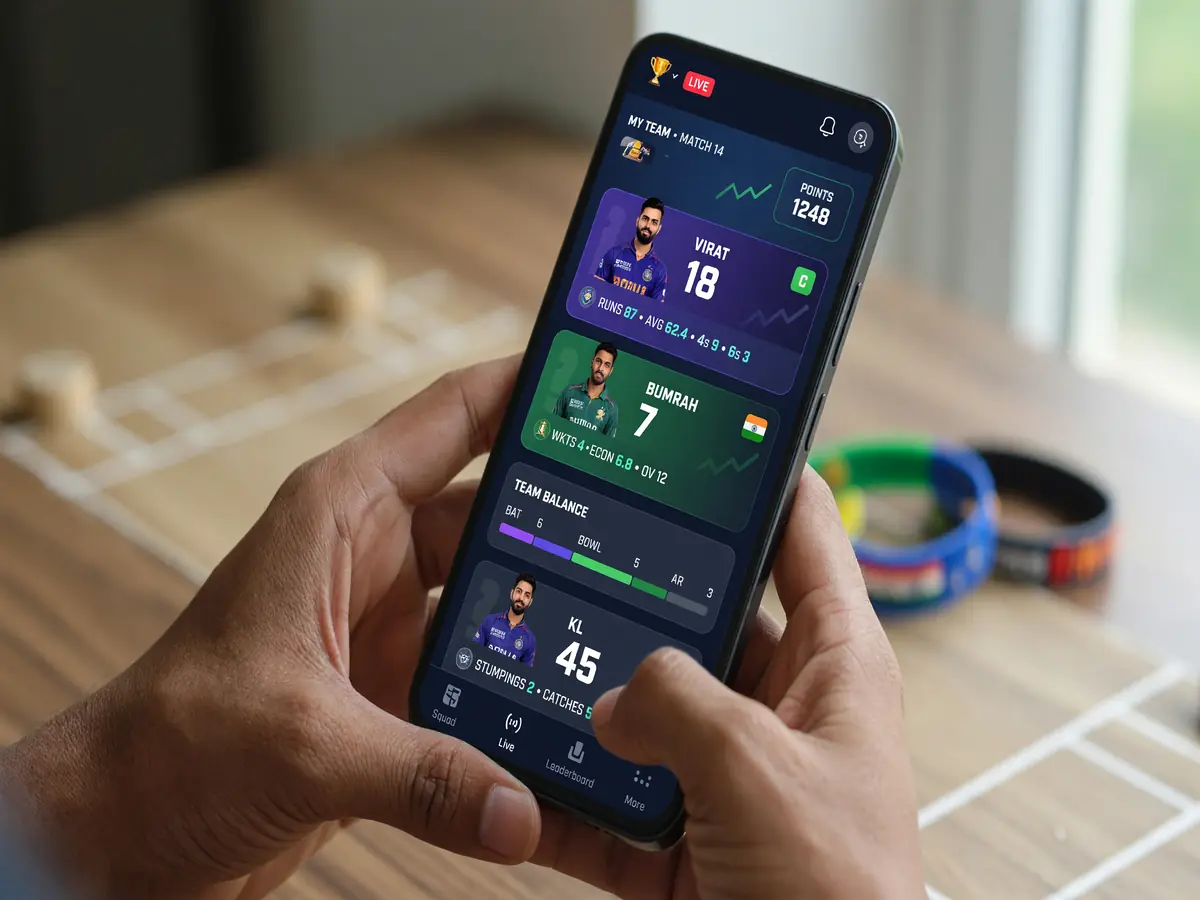
Most fantasy cricket formats give you 100 credits to spend on eleven players, with role limits. The exact role limits vary, but a typical setup is:
- 1 to 4 wicketkeepers
- 3 to 6 batters
- 1 to 4 all-rounders
- 3 to 6 bowlers
You can pick from any team in the match, with a maximum of 7 players from one side in most formats. The credit cap is the real constraint — top-order batters and frontline bowlers cost the most, and you will not be able to pick every marquee name. The job is to find value, not to pick favourites.
Captain and vice-captain, in plain language
The captain's score is multiplied by 2x. The vice-captain's is multiplied by 1.5x. These two picks decide the shape of your contest. A captain who scores 80 will give you 160 points; a captain who fails gives you half a top-order batter's worth of points.
Use a method. Three passes through the captain pick is one we recommend and explain in the captaincy method article:
- Floor: the worst realistic score, given the role and the conditions.
- Ceiling: the upside if everything goes right.
- Role certainty: how likely the player is to bat or bowl through the innings.
Contest types, and which one matches your team
You can enter as many contests as you like with the same team, but the contest shape changes the kind of team you want.
Head-to-head and small leagues
You are ranked against a small field. The optimal captain is the one most likely to outscore a single rival's captain. Safer, high-floor picks tend to win here.
Mid-size leagues (50 to 1,000 entries)
You need a balance. A pure floor captain will tie with half the field; a pure ceiling captain will finish first or last. Look for the captain with the smallest gap between floor and ceiling — the consistent scorer, not the explosive one.
Large GPPs
You need a contrarian edge. If your captain is on 60% of teams, you cannot separate yourself. A 15-25% owned captain with a high ceiling can carry a GPP entry. The catch is that the same logic applied by thousands of other players drives ownership of every high-upside name, so you need a view that is not yet consensus.
Abandoned matches, DLS and the rules to read first
Two scenarios can wreck a team after the toss: rain and player pullout. Read the operator's rules on both before you enter a paid contest.
Abandoned matches
If the match is abandoned without a ball being bowled, most operators refund the entry fee. If a result is reached under DLS, the operator's points system is applied to the abbreviated score. If the match is washed out mid-innings, the policy varies — some operators apply the points scored to that point, some apply the full DLS-par score. Read the policy.
Player pullout
If a player in your XI is not in the playing eleven, the operator's policy decides whether you get a substitute. Some operators let you swap before the toss; others zero the slot. The safest habit is to confirm the playing XI from the operator's push notification or the broadcaster's announcement, then submit your team.
What a method looks like in practice
Here is a worked example, using a fictional India–Australia ODI on a used pitch in Mumbai.
- Captain candidate 1: a top-order batter, in form, has batted through the innings in five of his last seven ODIs. Floor 35, ceiling 110.
- Captain candidate 2: a death-overs bowler, wickets are flat, hard to take more than two. Floor 25, ceiling 75.
- Captain candidate 3: a wrist-spin all-rounder, likely to bowl in the middle overs and bat at 7. Floor 30, ceiling 90.
For a head-to-head, candidate 1 is the right pick. For a 5,000-entry GPP with rain in the forecast, candidate 3 — because the middle overs will dominate a shortened game, and a 15% owned captain with a 60-point ceiling can separate you from a 60% owned candidate 1.

Common first-time mistakes
- Picking the captain you support, not the captain with the best method fit.
- Loading the team with top-order batters and forgetting the bowling points.
- Entering a 100,000-entry GPP with a low-floor captain.
- Editing the team after the deadline out of panic. The deadline is the deadline.
- Ignoring the role limits until the credit cap forces a swap you do not want.
What to read next
The points system page lists the exact scoring table and worked examples. The fantasy tips page is a set of selection templates you can copy. If you have not verified the app yet, the Fan2Play app guide is the first place to start.
Editorial reminder
This guide describes the typical fantasy cricket flow. The exact credit cap, role limits, captain multiplier, and abandoned-match policy are set by the operator. Always read the rules panel on the contest page before you enter.
What is the credit cap on Fan2Play?
Most contests use a 100-credit cap. The exact value of each player is set by the operator and is visible in the team creation screen.
Can I change my team after the toss?
No. The team is locked at the contest deadline, which is usually the toss. After that, only the operator can apply a substitute if a player is missing from the playing XI.
What happens if a match is abandoned?
It depends on the operator. Most refund the entry fee if no ball is bowled, and apply the operator's points system to the DLS result if a result is reached. Read the rules on the contest page.
How many contests can I enter with the same team?
As many as you like, in the same match. You cannot reuse the same team across different matches.